Which bus system do I have, and what do I need for the Hub?
Answer a few short questions and get the right parts for your bus. Your answers stay in your browser; we don't store them.
Step 1 of 3
- Bus systemNow
- Free connectorOpen
- DistanceOpen
- RecommendationOpen
Which bus system do you have on board?
Choose the bus system already installed on board. Not sure? The identification help below will guide you.
Please choose an answer.
Is there a free connector on your bus?
A free port on a T-piece or distributor carries only a protective cap.
A free port is a connector on a T-piece or distributor that carries only a protective cap. If a cable or a terminator is plugged in, the port is taken. If you can't find a free port, choose No.
Please choose an answer.
How far is the Hub from the bus?
Roughly measure the distance between the Hub and the bus.
Please choose an answer.
How far is the Hub from the bus?
Roughly measure the distance between the Hub and the bus.
Please choose an answer.
How far is the Hub from the bus?
Roughly measure the distance between the Hub and the bus.
Please choose an answer.
How far is the Hub from the bus?
Roughly measure the distance between the Hub and the bus.
Please choose an answer.
Which connector is this?
Compare shape, colour and locking mechanism with your connector.
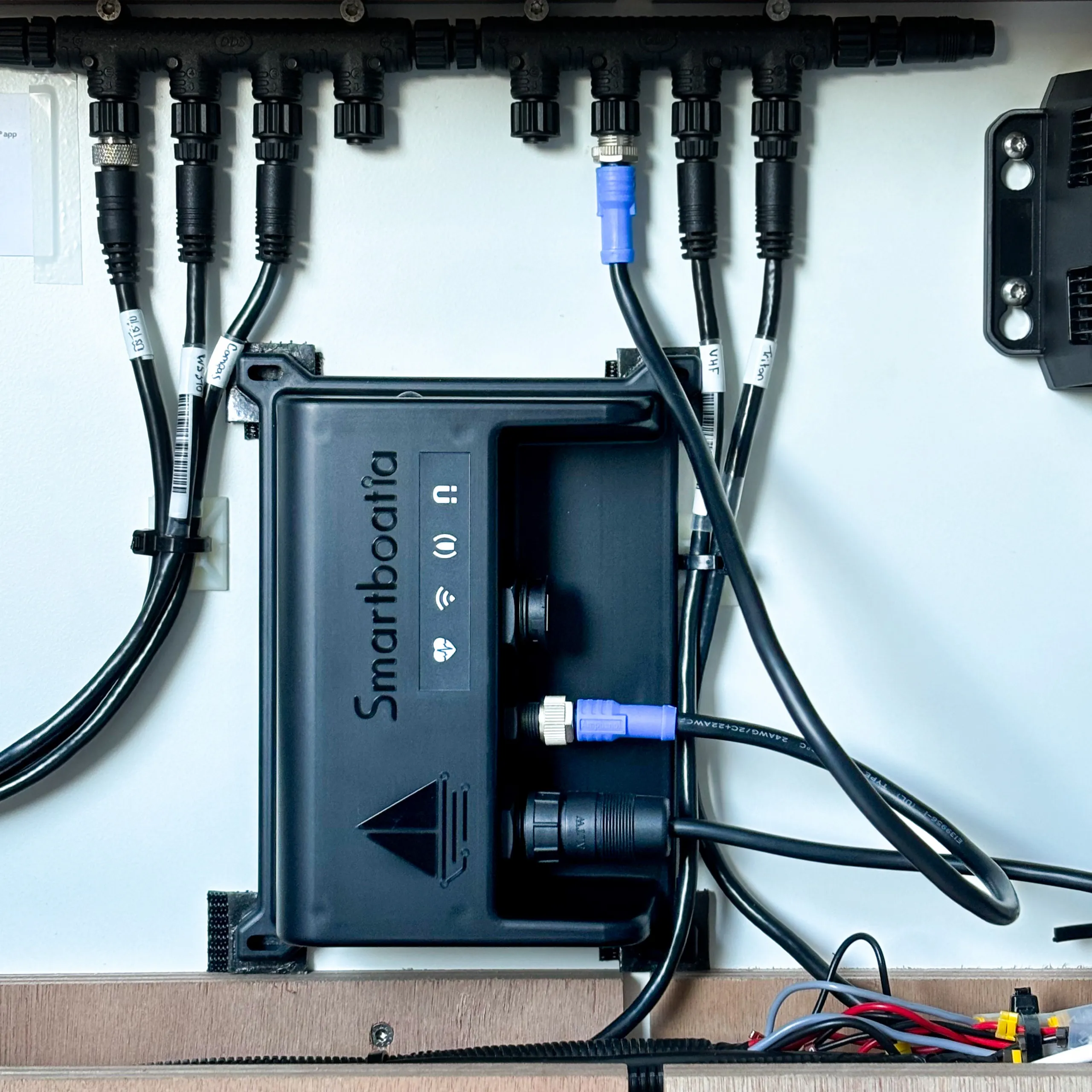
NMEA 2000
- Shape
- Round, five-pin, screw-lock (M12)
- Colour
- Black or grey
- Locking mechanism
- Screw lock

Raymarine SeaTalkNG
- Shape
- Round, twist-lock
- Colour
- Backbone blue, spur cable white, power cable with a red stripe
- Locking mechanism
- Twist lock (bayonet)

Raymarine SeaTalk 1
- Shape
- Flat, elongated, three-pin
- Colour
- Cores red (12 V) and yellow (data), plus shield
- Locking mechanism
- Push connector, no twist lock

Simrad SimNet
- Shape
- Round, yellow connector
- Colour
- Bright yellow on a black cable
- Locking mechanism
- Push-lock, terminator with a red ring

NMEA 0183
- Shape
- Individual wire pairs, no shared bus cable
- Colour
- Varies by manufacturer
- Locking mechanism
- Usually screw terminals
Your recommendation
Your answers

Total €0.00
- The Hub comes with its own power cable (8 to 28 V DC) and is not powered over the bus.
- An NMEA cable is not included.

Your recommendation
Your answers

Total €0.00
- The Hub comes with its own power cable (8 to 28 V DC) and is not powered over the bus.
- An NMEA cable is not included.
Your recommendation
Your answers

Total €0.00
- The Hub comes with its own power cable (8 to 28 V DC) and is not powered over the bus.
- An NMEA cable is not included.
Your recommendation
Your answers
Total €0.00
- The Hub comes with its own power cable (8 to 28 V DC) and is not powered over the bus.
- An NMEA cable is not included.
Your recommendation
Your answers

Total €0.00
- The Hub comes with its own power cable (8 to 28 V DC) and is not powered over the bus.
- An NMEA cable is not included.
Your recommendation
Your answers

Total €0.00
- The Hub comes with its own power cable (8 to 28 V DC) and is not powered over the bus.
- An NMEA cable is not included.
Your recommendation
Your answers
SeaTalk 1 connects to the Hub through a converter. We can't confirm without checking whether your specific autopilot delivers every value over this path; get in touch if you're unsure.

Total €0.00
- The Hub comes with its own power cable (8 to 28 V DC) and is not powered over the bus.
- An NMEA cable is not included.
Your recommendation
Your answers

Total €0.00
- The Hub comes with its own power cable (8 to 28 V DC) and is not powered over the bus.
- An NMEA cable is not included.
Your recommendation
Your answers

Total €0.00
- The Hub comes with its own power cable (8 to 28 V DC) and is not powered over the bus.
- An NMEA cable is not included.
Your recommendation
Your answers

Total €0.00
- The Hub comes with its own power cable (8 to 28 V DC) and is not powered over the bus.
- An NMEA cable is not included.
Your recommendation
Your answers
Total €0.00
- The Hub comes with its own power cable (8 to 28 V DC) and is not powered over the bus.
- An NMEA cable is not included.
Your recommendation
Your answers


€109.90
Total €0.00
- The Hub comes with its own power cable (8 to 28 V DC) and is not powered over the bus.
- An NMEA cable is not included.
Your recommendation
Your answers
Diagram: mini backbone to get started
€109.90
Total €0.00
- The Hub comes with its own power cable (8 to 28 V DC) and is not powered over the bus.
- An NMEA cable is not included.
Every recommendation at a glance
NMEA 2000
Round, five-pin screw connectors (M12), usually black or grey, often on a T-piece.
| Your situation | What you need |
|---|---|
| Yes, a port is free, 1 m | NMEA2000 Drop Cable – 1 m €22.90 |
| Yes, a port is free, 2 m | NMEA2000 Drop Cable – 2 m €26.90 |
| No, every port is taken, 1 m | Amphenol NMEA 2000 Micro-C T-Piece €16.50 NMEA2000 Drop Cable – 1 m €22.90 |
| No, every port is taken, 2 m | Amphenol NMEA 2000 Micro-C T-Piece €16.50 NMEA2000 Drop Cable – 2 m €26.90 |
Raymarine SeaTalkNG
Blue backbone cables, white spur cables, power cable with a red stripe, twist-lock connectors.
| Your situation | What you need |
|---|---|
| Yes, a port is free | Adapter Cable SeaTalk NG to NMEA 2000 – female 40cm €48.00 |
| No, every port is taken | Raymarine SeaTalk NG T-Piece (A06028) €27.00 Adapter Cable SeaTalk NG to NMEA 2000 – female 40cm €48.00 |
Raymarine SeaTalk 1
Three-core cables (red, yellow, shield), flat, elongated, three-pin connectors.
SeaTalk 1 connects to the Hub through a converter. We can't confirm without checking whether your specific autopilot delivers every value over this path; get in touch if you're unsure.
| Your situation | What you need |
|---|---|
| Raymarine SeaTalk 1 | Raymarine SeaTalk1 to SeaTalk NG Converter Kit (E22158) €139.00 Adapter Cable SeaTalk NG to NMEA 2000 – female 40cm €48.00 |
Simrad SimNet
Bright yellow connectors on black cables, terminator with a red ring.
| Your situation | What you need |
|---|---|
| Yes, a port is free, 1 m | Simrad SimNet to NMEA 2000 Adapter Cable, female, 1 m (24006199) €39.00 |
| Yes, a port is free, 4 m | Simrad SimNet to NMEA 2000 Adapter Cable, female, 4 m (24006413) €78.00 |
| No, every port is taken, 1 m | Simrad SimNet T-Joiner, 3 Ports (24005860) €32.00 Simrad SimNet to NMEA 2000 Adapter Cable, female, 1 m (24006199) €39.00 |
| No, every port is taken, 4 m | Simrad SimNet T-Joiner, 3 Ports (24005860) €32.00 Simrad SimNet to NMEA 2000 Adapter Cable, female, 4 m (24006413) €78.00 |
NMEA 0183
Older onboard electronics, usually individual wire pairs rather than one shared bus cable.
| Your situation | What you need |
|---|---|
| NMEA 0183 | Yacht Devices NMEA 0183 to NMEA 2000 Gateway, Micro-C (YDNG-03N) €199.00 NMEA2000 Starter Kit Plus €109.90 |
No bus system yet

No bus system is installed on board yet.
Diagram: mini backbone to get started
| Your situation | What you need |
|---|---|
| No bus system yet | NMEA2000 Starter Kit Plus €109.90 |
- The Hub comes with its own power cable (8 to 28 V DC) and is not powered over the bus.
- An NMEA cable is not included.
Does the Hub fit my boat?
- Power: 8 to 28 V DC over its own cable, not over the bus
- Bus system: NMEA 2000, SeaTalkNG or SimNet directly by cable, SeaTalk 1 through a converter, no bus with the starter kit
- NMEA 0183: only through a translator
- Internet: Your Hub connects to marina or home Wi-Fi, a router or a hotspot. Hub cellular carries only alarms and live status, with the Standard subscription
- Mounting location: below deck in a dry place, not in the engine room and at least 2 m away from radio, compass and radar
Power over the bus is not supported; the Hub needs its own cable for that. NMEA 0183 directly, without a translator, is not supported; we currently only recommend going through the translator.
Frequently asked questions
Can I mix devices from several manufacturers?
Yes, as long as they fit the same bus. NMEA 2000, SeaTalkNG and SimNet work together with the right cables and adapters; NMEA 0183 runs independently of the other systems.
Where do I feed power into the Hub?
The Hub gets its power through its own cable straight from your boat's battery (8 to 28 V DC), not over the bus.
What is a terminator, and do I need one?
A terminator closes off the bus at each end. If your bus is already fully wired, one is usually already in place; the Hub itself needs no extra one.
Do I need a T-piece?
Only if no port is left free on your bus. Then a T-piece or a distributor shares an existing connection.
Why isn't an NMEA cable included?
Every bus and every cable length needs a different cable. So you don't pay for something you might already have, you choose the right one here.
I have SeaTalk 1, does that work too?
Yes, through a converter. We can't confirm without checking whether your specific autopilot delivers every value that way.
Still not sure?
Send us a photo of your connectors, and we'll tell you what you need.
Send a photo